Mental Load
You Don't Need a Better Calendar. You Need Someone to Carry It With You.
The mental load isn't a scheduling problem. It's a reading, deciding, and remembering problem. And no shared calendar can solve it.
6 min read · Jan 15

We've all been there. Your kid walks through the door crying because you forgot something. Maybe it was the yearbook order. Maybe it was the permission slip that got lost in the pile, and now they're the only kid not going on the field trip. Maybe it was the costume for the class play, the teacher gift, the signup that closed yesterday.
This is the mental load of modern parenting, and despite a dozen family calendar apps promising relief, most moms still feel like they're carrying it alone.
You know it isn't because you don't care. It's that there is so much to remember. So many emails, flyers, group texts, schedules, and small decisions that have to be made on behalf of small people who can't make them yet.
If you're anything like me, you're amazed by the sheer volume of information you're expected to hold in your head to make sure your kid isn't the one left out. And you've probably tried to fix it. You downloaded the family calendar app. You started a shared Google Calendar with your partner. You color-coded it. You made a system.
And here's the thing nobody says out loud: it didn't really help.
The problem was never that you needed a better place to store information. The problem is that someone, usually you, has to read every email, decide what matters, and remember it at exactly the right moment. A calendar doesn't do any of that.
The calendar is the wrong tool for family life.
Why Family Calendars Don't Reduce the Mental Load
Every shared family calendar is sold with the same promise. Get organized. Get aligned. Reduce stress. Finally, everyone on the same page.
But a calendar just sits there. It waits for you to put something in it, and it waits for you to come look at it later. It doesn't read the email from your daughter's teacher. It doesn't notice that the field trip permission slip is due Friday. It doesn't tell you that today is the day your son needs to bring a white t-shirt for the science experiment.
You do all of that. Every single time.
A shared calendar doesn't reduce the mental load. It just makes it look prettier.
The work isn't keeping the calendar. The work is being the one who reads, decides, and remembers everything coming at your family.
The Three Jobs of the Mental Load: Reading, Deciding, Remembering
When people talk about the mental load, they usually picture a long to-do list. But that isn't quite right. The to-do list is the tip of the iceberg. The real work is everything underneath.
It's actually three jobs happening at once, all day, every day.
The first is reading. Every email from every school. Every group text from every team. Every flyer that comes home crumpled in a backpack. Every announcement in every parent portal. The volume is staggering, and most of it doesn't matter on any given day.
The second is deciding. Sorting the "good to know" from the "if you miss this your kid will cry." Figuring out which parent needs to act, when, and how. Translating "spirit day" into a specific shirt in a specific color for a specific kid.
The third is remembering. Holding all of it in your head and surfacing the right piece at the right moment. Not the night before, when you can't do anything about it. Not the morning of, when it's too late. The exact right moment.
A calendar can sort of help with the third job, and only if you remember to look at it. It does nothing for the first two. That work still lives in your head, which is why it almost always ends up there permanently.
If you've ever felt like you're holding too much, it's because you are. And you've probably been doing it almost entirely alone.
Job 1
Reading
Job 2
Deciding
Job 3
Remembering
What Moms Actually Need: An Assistant, Not Another App
Here's what would actually help. Not a prettier grid. Not more reminders to set yourself. Not another app to check.
What would actually help is a text in the morning that tells you what today requires. Not seven calendar events to scan, just the things that matter. White shirt for science. Pickup is at the other school. Soccer is cancelled because of rain.
What would actually help is a reminder at 2pm that today's pickup is different, because today is different.
What would actually help is being able to text a question, like "what are we doing on Saturday?" or "when is the field trip form due?" and get an answer instead of going to hunt for it.
In other words, what would actually help is someone reading the emails, sorting them for relevance, and telling you the things you need to know, when you need to know them.
That isn't a calendar. That's an assistant.
How Smitty Works: A Family Assistant That Carries It With You
I built one for my family. I called it Smitty.
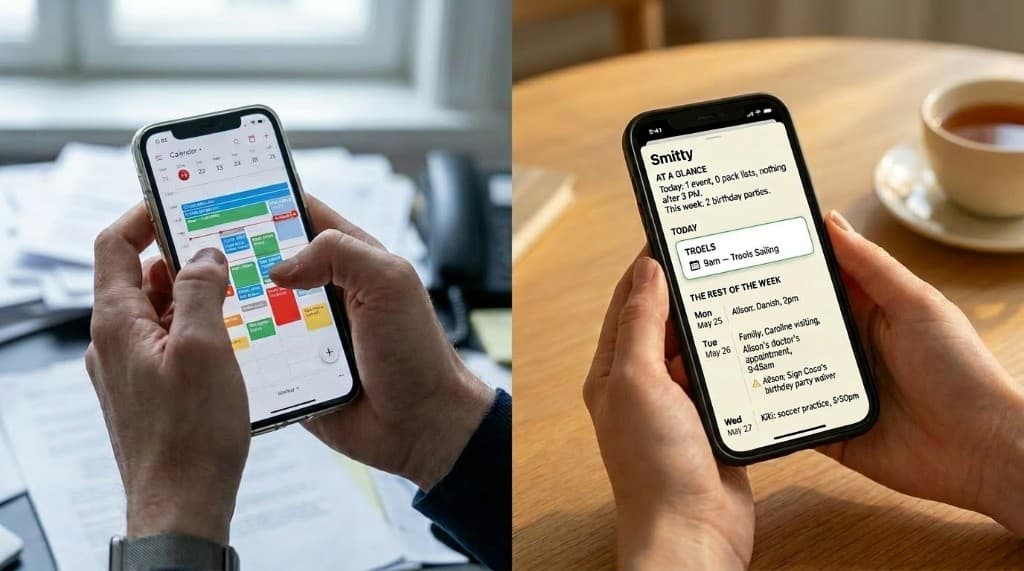
You forward your school emails to it. You snap a picture of the flyer. Or send a quick text after chatting with another mom about a playdate. Smitty reads all of it, figures out what matters, and remembers everything. You get a calm morning text that tells you what today actually needs. You get reminders at the moments you need them. You can text it any time and just ask.
There's a calendar in the background too, so your partner or your nanny can see what's coming. But you almost never need to look at it. Smitty tells you.
The moment I knew it was working: I was recovering from surgery. My stepdaughter was recovering from her own surgery. Her coach sent an email because she'd quietly signed up to host her team's end-of-year party. I would have missed it completely. I was barely tracking my own medication. I was definitely not reading emails from rugby coaches after the end of the season. But Smitty read it, flagged it, and let me know that we needed to pay attention.
We had enough time to coordinate with her mom to have the party at their house, so everyone got what they wanted: a restful day for me and a rugby cookout for my stepdaughter.
That's what I want this to feel like for every mom. Not a prettier place to file the chaos. Something that actually carries some of it with you.
You're Not Failing. The Tools Are.
If you've ever cried in the car because you forgot something, or laid awake at 11pm running through tomorrow in your head, or felt a wave of guilt when another mom mentioned the thing you didn't know about, I want you to hear this clearly.
You are not the problem. You are doing an enormous, invisible, exhausting job, and the tools you've been handed were built for filing, not for carrying.
You don't need to be more organized. You don't need a better system. You need something that does the reading, the deciding, and the remembering with you.
I built Smitty because I needed it. I'm sharing it because I know I'm not the only one.
Smitty is here to tell you what you need to know, when you need to know it. Nothing more, nothing less.
Try Smitty free for 30 days.
Let Smitty read the family logistics pile with you, then text you what matters when it matters.
Frequently Asked Questions About the Mental Load and Family Calendars
What is the mental load of motherhood?
The mental load is the invisible work of anticipating, planning, and remembering everything a family needs to function. It includes reading every school email, deciding what matters, and remembering details at exactly the right moment — work that typically falls on mothers and rarely gets acknowledged or shared.
Why don't shared family calendars reduce the mental load?
Shared calendars only solve the storage problem, not the cognitive work. Someone still has to read every email, decide what's important, enter it into the calendar, and remember to check it. The calendar is a filing cabinet, not an assistant — it doesn't read, decide, or surface information for you.
What's the best family organization app for working moms?
The best tool depends on what kind of help you need. Traditional family calendar apps like Cozi or Google Calendar are good for shared visibility but require you to do all the input and remembering. Smitty is built differently — it reads your school emails, sorts what matters, and texts you what you need to know, when you need to know it.
How is Smitty different from Cozi or Google Calendar?
Cozi and Google Calendar are calendars first. You put information in, and you look at it later. Smitty is an assistant first. You forward emails and snap flyers, and Smitty texts you the things that matter at the right time. There's a calendar in the background for your partner or nanny, but you almost never need to look at it.
Is the mental load really invisible labor?
Yes. The mental load is one of the most studied forms of invisible labor in modern households. Research consistently shows mothers do the majority of cognitive and emotional household work — including planning, scheduling, and remembering — even in dual-income families. It rarely shows up on a to-do list, which is part of why it goes unrecognized.